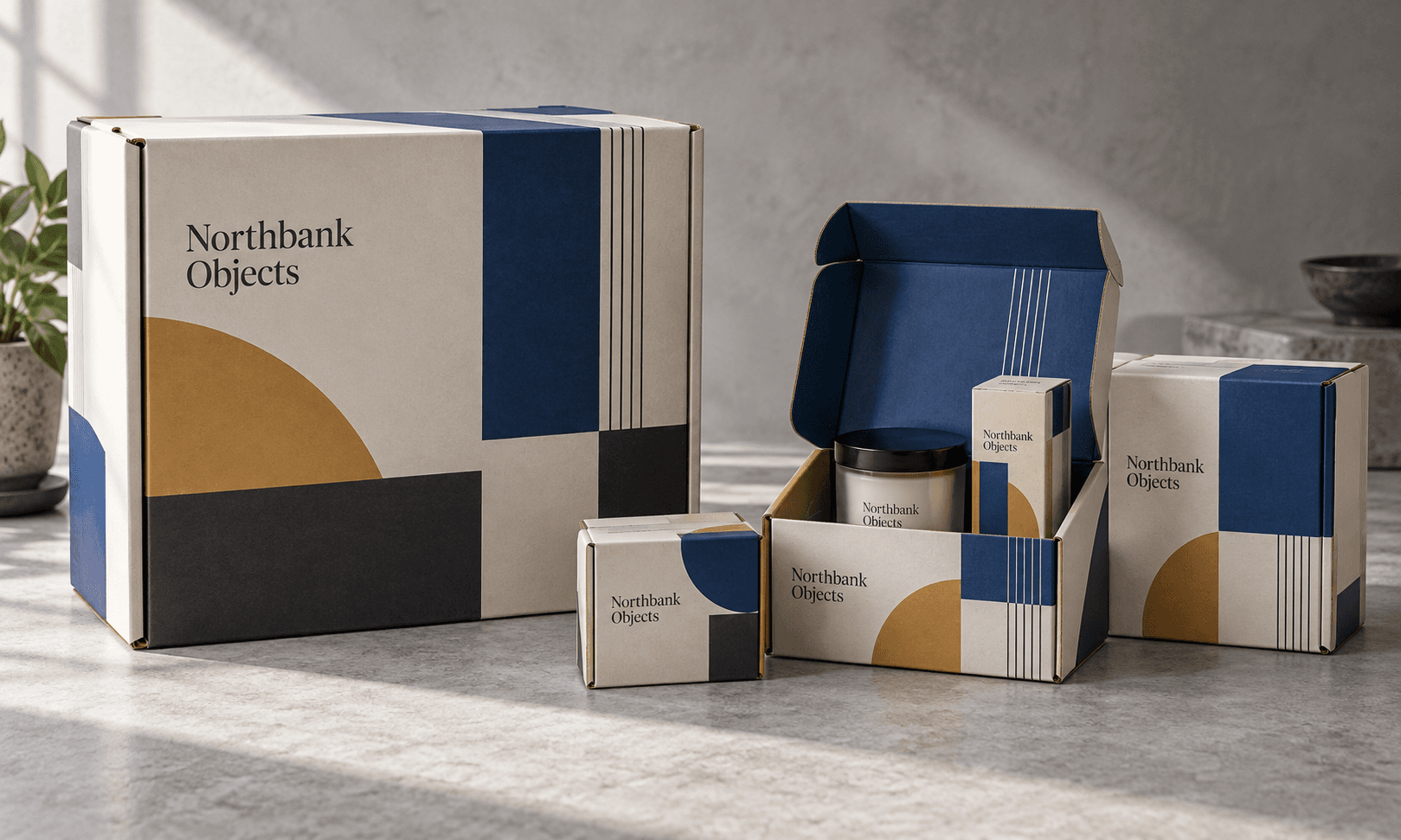
Cubic weight can make a light parcel expensive because carriers do not only care about what a shipment weighs on the scales. They also care about how much space it occupies.
That is why box size deserves the same attention as board grade, print and product protection. A parcel can weigh 2 kg physically but be charged as a much heavier shipment when the outer carton is unnecessarily large.
My rule is simple: use the smallest practical shipping size that still protects the product, packs efficiently and arrives in good condition. Chasing the smallest possible carton is not the goal. Removing wasted space without creating a new problem is.
For brands working with Custom Packly, that means looking at the complete packed parcel, not only the product dimensions.
Cubic Weight Is Not the Same as Actual Weight
Actual weight is what the packed parcel weighs on a scale. Cubic weight, also called dimensional weight, estimates how much transport space the parcel uses.
Chargeable weight is the figure the carrier uses to price the shipment under the rules of that service. Depending on the carrier and service, that may be actual weight, cubic weight, a size-and-weight tier or another pricing method.
Actual weight
Actual weight includes the product, box, insert, void fill, tape and anything else travelling with the shipment.
If the finished parcel weighs 2.4 kg, its actual weight is 2.4 kg.
Cubic weight
Cubic weight is calculated from the parcel's external dimensions.
For Australia Post, the current cubic conversion factor is 250 kg per cubic metre. Its formula is:
Length × width × height in metres × 250
A parcel measuring 40 cm × 30 cm × 20 cm therefore has a cubic weight of:
0.40 × 0.30 × 0.20 × 250 = 6 kg

Australia Post states that when cubic charging applies, postage is assessed using the greater of actual weight or cubic weight. Its current cubic-weight information is worth checking before you model a packaging change because service rules can change.
Chargeable weight is the number that matters commercially
If that 40 × 30 × 20 cm parcel physically weighs 1.8 kg but its cubic weight is 6 kg, the difference between the two numbers is where packaging design can start affecting freight economics.
Do not assume every carrier uses Australia Post's formula. Some services work with volume limits, parcel tiers, contract rates or different conversion factors. Always model your own carrier arrangement.
Why a Few Centimetres Can Matter More Than Expected
Box dimensions multiply. That is the part many businesses underestimate.
Reducing one dimension helps. Reducing two or three at the same time can change the parcel volume much more sharply.
A box that is 10% smaller in each dimension is not merely 10% smaller in volume. Its total volume falls by about 27%.

This is why oversized packaging can quietly become expensive across thousands of orders. The waste is not only cardboard. You may also be paying to move empty air.
If your ecommerce team is choosing between different shipping structures, custom shipping and postal boxes should be specified around the packed product and freight method rather than a convenient generic carton size.
External dimensions matter
Use the finished external parcel dimensions for freight calculations.
The size printed on a box specification may be an internal dimension. Board thickness, folded panels, closures and product pressure can increase the outside measurement.
Australia Post also warns that bulging contents, loose flaps and protruding parts can affect measured dimensions. A box that technically measures 300 mm high on a drawing but bows to 320 mm after packing is not behaving like a 300 mm parcel anymore.
That is one reason I do not recommend selecting a shipping carton from product dimensions alone.
Illustrative Case Study: A Skincare Parcel Carrying Too Much Air
Consider an illustrative skincare business shipping several bottles and cartons in one ecommerce order. This is a worked example, not a claimed Custom Packly client result.
The packed products weigh 1.8 kg.
The first outer box measures:
Using Australia Post's 250 conversion factor, the cubic weight is 6 kg.
The box has plenty of empty space around the products, so the packer adds crumpled paper to stop movement.
Now redesign the pack around the actual product arrangement. A fitted paperboard insert holds the bottles upright and removes the need for most loose fill. The outer carton becomes:
The new cubic weight is:
0.30 × 0.22 × 0.14 × 250 = 2.31 kg
The actual products have not become lighter. The redesign has reduced calculated cubic weight from 6 kg to 2.31 kg, about 61.5%.
That does not mean the freight invoice automatically falls by 61.5%. Carrier rates, destination, contract terms and pricing tiers decide the real dollar saving. But the packaging has removed a major source of unnecessary chargeable volume.

This is where custom inserts and dividers can earn their place. An insert should not be added merely to make the inside look organised. It should control product movement, simplify packing or allow a more efficient outer box.
Smaller Is Not Automatically Better
I would reject any packaging recommendation based only on reducing cubic weight.
The best shipping box is not the smallest box you can physically close. It is the smallest practical box that still performs properly.
A carton can become too tight when:
If a tighter box saves freight but increases damage, re-packing or customer complaints, the total cost has gone in the wrong direction.

For fragile or heavier shipments, the answer may be a more efficient structure rather than simply less board. Custom corrugated shipping boxes can be specified around product weight, stacking, handling and transit risk before dimensions are finalised.
One Universal Box Can Become an Expensive Convenience
Using one box for many products can simplify inventory and packing. It can also mean paying for unused space on a large share of orders.
This is especially common when a business launches with a handful of products, chooses one shipping carton and then keeps using it as the product line grows.
A universal box still makes sense when order combinations are unpredictable or the operational savings outweigh the freight difference. But it should be a conscious decision.
Start with your order data.
Which products ship most often? Which combinations make up the majority of orders? How frequently is the biggest box actually necessary?
If 70% of orders are small and only 10% need the largest carton, forcing every order into the large box deserves scrutiny.
I use a practical threshold rather than chasing perfect theoretical efficiency: add another packaging size only when the expected saving in freight, materials or damage control is large enough to justify extra inventory and warehouse complexity.
The decision is closely connected to whether one box size or multiple sizes makes more sense. That choice should come from order patterns rather than aesthetics.
Void Fill Is Often a Symptom, Not the First Problem
Loose fill has a legitimate job. It can stop movement, cushion products and fill irregular spaces.
But excessive void fill can be a clue that the outer box is doing too much.
If a packer consistently needs large amounts of paper or air pillows to make the same product safe, ask why that empty volume exists.
Sometimes the fix is a smaller carton. Sometimes it is a die-cut insert. Sometimes the product orientation can change. Sometimes the board structure should change.

The useful question is not, "How much void fill should we add?"
It is, "What is the minimum empty space this shipment needs to survive normal handling?"
For products that need location control rather than soft cushioning, a fitted insert can be more repeatable. How to choose packaging inserts covers fit, material and cost decisions in more detail.
Corrugated Strength and Box Size Have to Be Chosen Together
Right-sizing cannot be separated from board performance.
A larger box with weak board can fail. A smaller box with the wrong flute can also fail. The product weight, stacking load, delivery method and unsupported panel area all matter.

Reducing the box size can sometimes improve performance because shorter panels flex less and the product has less room to move. But that does not mean you can automatically reduce board strength at the same time.
For ecommerce shipments, custom mailer boxes can work well when the product and delivery risk suit the structure. Heavier, fragile or multi-product orders may need a shipping carton with different compression and closure behaviour.
The sequence matters. Decide how the product needs to be restrained and protected, choose the structure, then refine the external dimensions.
Your Carrier May Price Volume Differently
Do not build a packaging saving model from one generic dimensional-weight formula and assume it applies everywhere.
Australia Post currently uses a 250 kg/m³ cubic conversion factor for relevant domestic services and generally compares cubic and actual weight where cubic charging applies.
Sendle currently asks Australian users to enter outer parcel dimensions and uses both weight and volume limits for its parcel sizes. Its domestic parcel size information also warns that excess loose packaging can contribute to measured volume and adjustment charges.
Other couriers, freight companies and negotiated business accounts may use different factors, thresholds or surcharges.
Before paying for a new packaging setup, check:
Packaging should be tested against your freight model, not an industry average.
Audit Your Existing Boxes Before Redesigning Anything
You do not need a complex warehouse study to find the obvious problems.
Start with your highest-volume products and order combinations.
For each packed order, record:

Accurate measurement matters. If you are unsure where internal and external dimensions differ, measuring a box correctly for custom packaging is the right starting point.
Find the biggest gaps first
I would not begin with every shipment.
Look for parcels where the space-based measure is much higher than the physical weight or where a small product regularly leaves the warehouse in a visibly oversized carton.
Those orders offer the clearest starting point.
Test the packed box, not an empty sample
A box can look ideal on the bench and behave differently once filled.
Load the real products. Add the real insert. Close the box. Measure the outside again. Check whether panels bow or closures rise.
If you are developing a new structure, the free packaging dieline generator can help establish accurate dimensions before artwork is finalised.
Model annual volume
A small per-parcel difference can become meaningful at scale.
Do not stop at "this box is 20 mm shorter". Multiply the expected freight change by the number of shipments that actually use that configuration.
Then compare that saving against any added packaging cost, tooling, warehouse space or packing time.
What I Would Change First
If I were reviewing an ecommerce packaging setup purely for cost and performance, I would work in this order:

That order matters because the cheapest packaging unit is not always the cheapest shipment.
Custom packaging should reduce the total cost of getting a product to the customer safely. Material cost, freight, packing labour, damage and storage all belong in the same decision.
Businesses sending regular online orders can also look at custom E-commerce packaging when the outer box, unboxing experience and delivery protection need to work as one system.
Cubic Weight Questions We Hear Most Often
Is cubic weight the same as dimensional weight?
Yes. The terms usually describe the same idea: converting parcel volume into a weight figure for freight pricing. The exact calculation and when it applies depend on the carrier and service.
Does Australia Post always charge cubic weight?
No. Australia Post has different rules depending on the service and packaging used. Where cubic charging applies, it generally assesses the greater of actual weight or cubic weight. Eligible flat-rate packaging can be treated differently, so check the current service rules before making a cost forecast.
Should I make every shipping box as small as possible?
No. The goal is to remove unnecessary space without reducing protection or packing efficiency. A carton that is too tight can increase damage, slow fulfilment or bulge beyond its intended dimensions.
Can an insert reduce shipping costs?
Potentially. An insert can hold products in a smaller footprint and reduce the need for loose fill, which may allow a smaller outer box. But the insert itself takes space and adds material cost, so it needs to improve the total pack rather than simply add another component.
Are external box dimensions more important than internal dimensions for freight?
Yes. Carriers measure the parcel they transport. Use the finished external dimensions when estimating cubic weight, including any bulging or protruding parts.
When should I use more than one shipping-box size?
Consider another size when a large share of orders is carrying avoidable empty space and the freight or material saving is large enough to justify extra inventory. Use actual order frequency to make that decision.
How can I estimate the saving before ordering new boxes?
Measure your current packed parcel, calculate its chargeable weight under your carrier's rules, then repeat the calculation using the proposed packed dimensions. Apply the difference to the number of shipments that will genuinely use the new size. Include any change in box cost, inserts, packing labour and damage risk.
Reduce Empty Space Without Creating a Weaker Shipment
Cubic weight turns box dimensions into a commercial issue. The wrong carton can increase freight cost even when the product itself is light.
The answer is not aggressive downsizing. It is controlled right-sizing: enough structure and clearance to protect the product, without paying to ship space that does nothing useful.
If your current boxes have large voids, inconsistent packing or cubic weight far above actual weight, get a quote with your product dimensions, packed weight, current box size and order quantity. We can assess the structure around the product rather than starting from a generic carton.